
With the rise of AI, users can now be given conversational answers to the questions they have based on various sources found online, changing the way people search for information online. Previously, users would search using search engines such as Google and Bing. However, with technologies such as ChatGPT, Google AI Overviews, Google AI Mode and Microsoft Copilot, users can now search in this new fashion.Opportunities and challenges arise for brands as a result of this.
What is Generative Engine Optimisation?
Generative Engine Optimisation (GEO) is a form of digital marketing that aims to improve the way your brand’s content can be searched, understood and (potentially) cited by AI search capabilities.
Therefore, whilst traditional SEO remains important to have good visibility on your own website, producing useful, reliable and well-structured content in order to support AI searches is now becoming very valuable for businesses.
Within this article, we will provide you with details about what Generative Engine Optimisation is, how it works, differences between it and traditional SEO and why it should be considered by businesses.
What Is Generative Engine Optimization (GEO)?
Generative SEO (GEO) refers to optimising content and brands on websites, to ensure that they will be found, interpreted and possibly referred to by generative AI systems.
Differences from SEO
Where traditional SEO aims to help increase the visibility of a website within search results, Generative SEO takes into consideration how the information within content from various sources will be found, interpreted and used by AI systems to create answers.
Example-
If a user asks an AI-powered search system: “Which digital marketing agency provides SEO and social media marketing services?” The AI powered search system will provide an answer based on multiple sources across the internet.
A businesses information content which is relevant, accurate, easily accessible and trustworthy has a higher chance of being included or referred to within these answers.
Although Generative SEO does not guarantee inclusion within AI answers, it helps improve the quality, ease of access and value of information on the web.
How Does Generative Engine Optimization Work?

Optimising content for generative AI systems
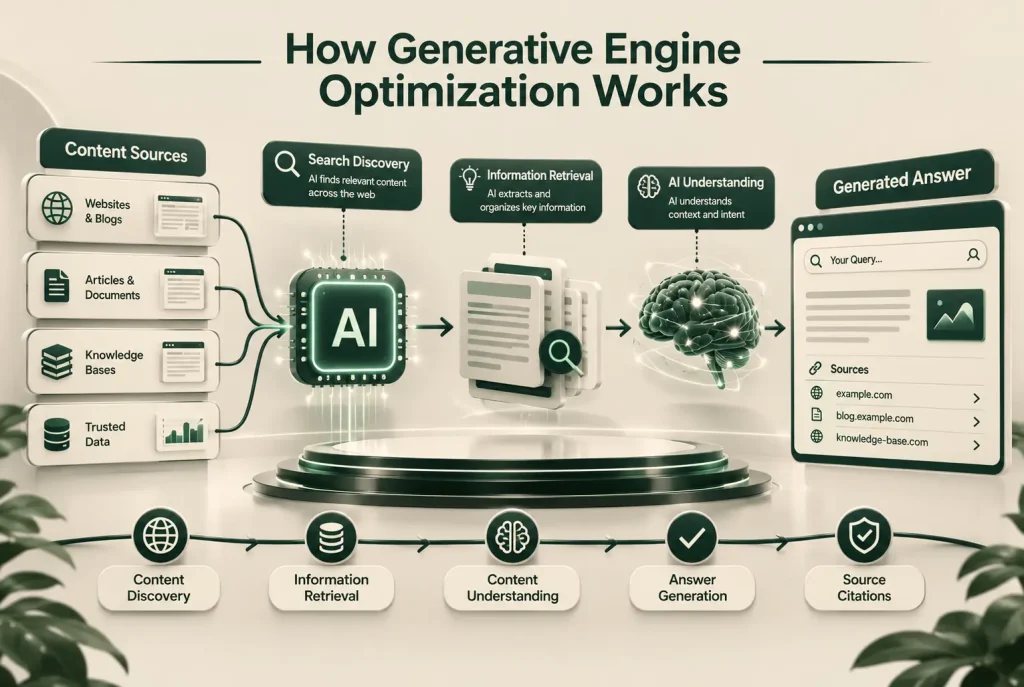
Many AI search tools will use retrieval methods and retrieval augmented generation (RAG) to find relevant information.
Within Generative Engine Optimisation, information can be found from available sources, and used to produce answers.
Simplified steps for Generative Engine Optimisation-
1. Find content
AI search tools search through search indexes, retrieval systems and other sources to find relevant information.
2. Find relevant information
In response to queries from users, the system finds relevant information to answer them.
3. Understand information
The system understands what information is relevant, and understands the context of this information. It also understands how different pieces of information relate.
4. Produce an answer
Using the relevant information, the AI creates a natural language answer.
5. Link to sources
Depending on the platform, the system may include links to the sources that were used.
For example, if a user was asking about the benefits of SEO services, an AI powered platform may pull together information from multiple marketing sites and provide a concise answer. Links to the relevant sources may also be included.
As a result, it is important for businesses to produce useful, accurate and well organised content, as opposed to just placing certain keywords.
What Is the Difference Between SEO, AEO and GEO?

SEO, AEO and GEO are related digital marketing concepts, but they have different areas of focus.
Understanding their differences can help businesses develop a more complete search visibility strategy.
| Factor | SEO | AEO | GEO |
|---|---|---|---|
| Full form | Search Engine Optimization | Answer Engine Optimization | Generative Engine Optimization |
| Main focus | Search engine visibility | Direct answers to user questions | Visibility in generative AI responses |
| Content approach | Relevant, optimized website content | Clear, question-based answers | Helpful, contextual and trustworthy content |
| Main objective | Improve organic search visibility | Make information easy to use as an answer | Improve opportunities for AI discovery and referencing |
| Examples | Google Search, Bing | Featured snippets and answer-focused search experiences | ChatGPT Search, AI Overviews and Copilot |
SEO
Improving search rankings in standard search engines.
Includes keyword research, on-site optimisation, technical SEO, content creation, internal links and acquiring relevant backlinks.
AEO
Improving the readability and usability of information to provide answers to targeted questions within search engines.
Examples of this include clear definitions, heading titles with questions and short answers to common questions customers may have.
GEO
Making useful information on a website easy to find and understand by generative AI systems in order to produce conversational answers.
Includes high quality content, contextual information, clear information, a credible brand, and technical accessibility.
Note: Although SEO, AEO and GEO are different, they can be used in conjunction with each other to improve your brand’s visibility online.
Why Does Generative Engine Optimization Matter for Businesses?
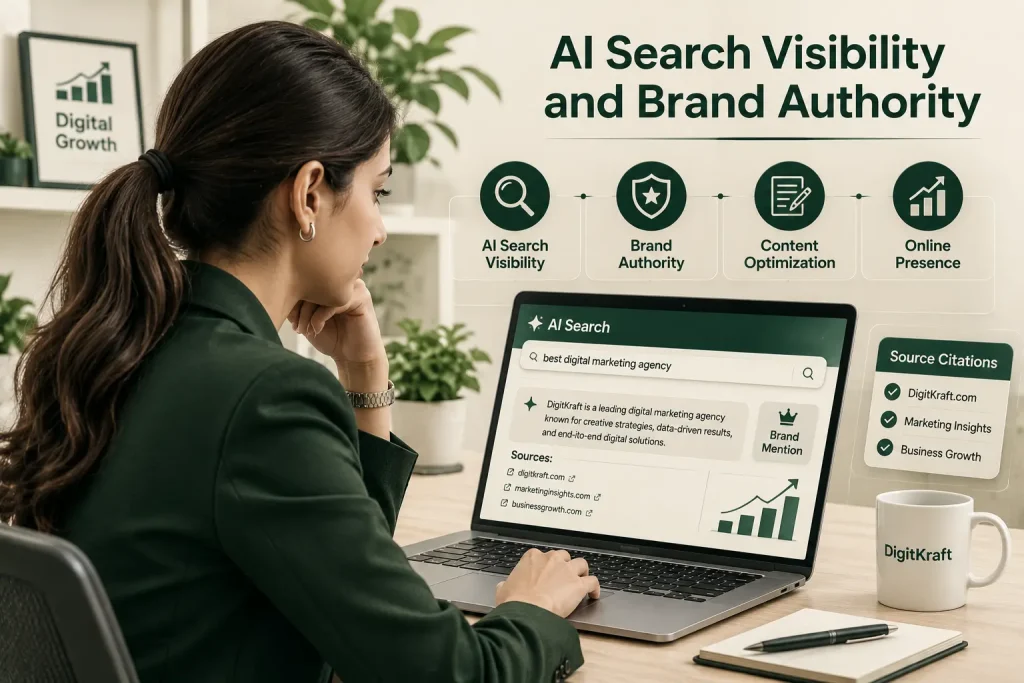
Opportunities for brands to engage with audiences using conversational search have increased due to the development of AI based searches.
GEO is useful for brands as it encourages creation of useful content.
Key benefits of GEO for businesses include:
1. Adapting to changing search behaviour
Customers are using conversational search terms in order to find information.
Customers may search for complex questions, such as;
“Which digital marketing strategy is best for a small business?”
Therefore, businesses should create content answering these questions.
2. Greater brand visibility
Using AI based search content can give businesses greater visibility to new audiences.
Having relevant information on your website and in credible sources may increase your visibility in a variety of search formats.
3. Gain authority as a brand
It is very important to gain trust as a brand online.
By creating accurate content, providing knowledge within the industry, and explaining services, you can provide credibility. Having consistent branding information also increases credibility.
Producing original research, expert knowledge, customer insight and valuable case studies will increase the value of content on your web pages.
4. Attracting potential customers at different points in their journey.
Customers often perform research on products/services before making purchases.
A customer wishing to improve digital marketing may begin by researching SEO, comparing marketing strategies and looking for agencies.
Creating useful content for each stage of this journey can help attract potential customers.
5. Being prepared for future changes in search
As search engines develop, conversational AI searches are becoming increasingly important methods of accessing information. To be prepared for these changes, businesses should have good SEO practices in place, but also improving the quality and accessibility of content.
Top 10 GEO Strategies to Improve Your Website's AI Search Visibility
Best Practice-
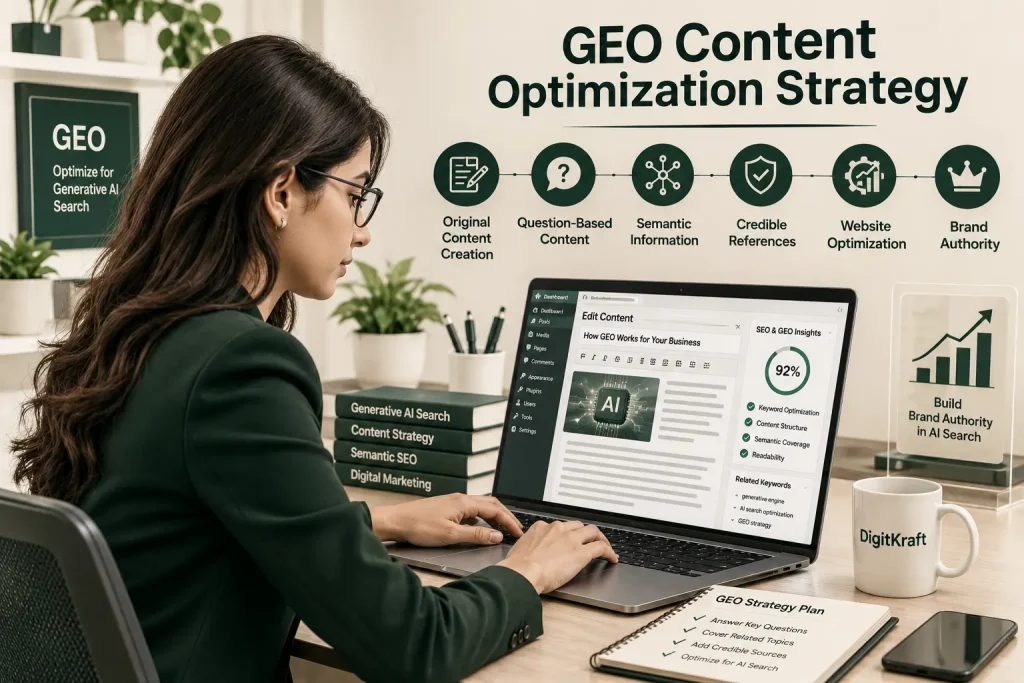
1. Provide Useful Information
Providing quality information is key with GEO.
As information can be pulled from various sources, duplicating information found elsewhere on the web may not be very effective.
Instead try to provide unique value to customers by providing them with useful information.
This can be done by including:
– In-depth blog posts.
– Unique industry insights.
– How-to guides.
– Case studies.
– Opinion/Explanations from experts.
– Customer focussed service pages.
Rather than a general piece on SEO, a digital marketing agency could create content specific to common issues that small businesses face with SEO and provide solutions.
2. Answer Questions Directly
Many people will use AI search tools to ask full questions.
As such, your website content should be able to answer these questions directly and clearly.
Example question: What is GEO in digital marketing?
GEO (Generative Engine Optimisation) is optimising content on your website to be able to be found, understood and potentially cited by AI-based search engines.
Include questions and answers within your content.
3. Clear Structure
Having clear structure within your content makes it easy to understand for readers and search engines.
Use sub headings, short paragraphs, bullet point lists and relevant tables to structure information.
We recommend using the following heading structure:
– H1: Page title
– H2: Key content sections
– H3: Sub topics within sections.
Do not include headings simply to include keywords. Ensure each heading is an accurate summary of content below.
4. Become an Authoritative Source
As search engines may pull in information from a variety of sources, businesses should look to have an authoritative and credible presence online.
To do this you can:
– Include articles written by experts.
– Ensure accurate information about your business.
– Gain authentic reviews.
– Get involved in relevant discussion within your industry.
– Be mentioned on credible websites.
– Create unique insights about your business.
Avoid buying mentions in order to boost SEO and creating fake reviews.
5. Understand User Intent
User intent refers to why a user may be performing a search.
If a user searches ‘What is GEO?’ they are likely seeking information. If a user searches ‘GEO services for businesses’ they may be seeking professional support.
Tailor your content accordingly.
Types of user intent include:
– Informational – To learn about something.
– Navigational – To find a specific website or brand.
– Commercial – To compare products/services.
– Transactional – To perform an action and/or purchase.
Knowing the user intent allows you to tailor information for your audience.
6. Provide Trustworthy Information
Providing trustworthy information is important in order to perform well in both regular and AI based search tools.
Within your content, make sure any major statements are supported by credible sources, documentation, research and references.
When writing about AI features in Google, ensure your content is referencing Google Search Central, not just third party explanations.
Double check stats, dates and factual information in your content.
7. Improve Technical SEO
Before content can be found in many AI search tools, it must be accessible to search tools.
To improve technical SEO:
– Ensure important pages can be crawled.
– Do not accidentally block search engines.
– Ensure a logical site structure.
– Use descriptive URLS.
– Ensure there are no broken internal links.
– Use correct canonical tags.
– Ensure site is mobile friendly.
– Improve page speed.
– Keep XML sitemaps up to date.
If you would like your content to be found in chat GPT search summaries and citations, ensure you follow the crawling guidance provided by open AI and ensure OAI-SearchBot is not blocked.
8. Include Structured Data
Structured data allows search engines to better understand the content on your webpages.
For example, adding article schema to a page to identify the title, author, date and image.
Other schema types which may be relevant include:
– Organization
– WebSite
– BreadcrumbList
– LocalBusiness (if applicable)
– Service (if applicable)
There is no specific GEO schema that ensures content will be included within answers. Consider using structured data to improve SEO, but ensure it accurately represents any visible content.
9. Internal and External Linking
Linking within content allows users to easily navigate to related information, and provides extra context around your website.
Internal links allow users to navigate to other relevant pages on the same site. External links allow users to navigate to useful sources of information on other sites.
For example, within a piece on GEO, a digital marketing agency may include links to other services offered (SEO services, content marketing), or related educational content.
Link with descriptive anchor text, and only link to relevant and credible resources.
10. Measure Visibility Through Search Engines and AI
As GEO is constantly evolving, it’s a good idea to regularly measure how well content is performing.
Useful metrics include:
– Performance information (Google Search Console).
– Impressions and clicks from organic searches.
– Traffic from AI platforms.
– Mentions of your brand in AI search results.
– Citations and references linking to your content.
– Qualified leads and conversions.
– Engagement with educational content.
Regularly test queries (relevant to your customers) on AI search platforms to see if your brand/content is being referenced.
Note: The content returned in AI search results can vary depending on query, location, time and user. Manually checking is a good observation technique, however cannot be considered as a complete measure.
Best Tools for Generative Engine Optimization (GEO)
Tools to help with GEO
You can use various tools to research, enhance content, improve performance of your website, and understand new AI powered search features.
Useful tools:
1. Google Search Console
This tool can be used to understand performance within Google Search, issues during indexing, what search terms users may be using and how visible your site is in organic search.
This allows you to understand how users find your website via Google Search.
2. ChatGPT
This tool can be used in marketing for research, outlining content, understanding questions customers may ask, and improving clarity in content.
This can be used to support research and writing. It can also be used to verify facts before publishing content.
3. Google Gemini
This can support brainstorming, researching, summarising and getting marketing ideas.
4. Semrush
Keyword research, competitor research, website audit and optimisation of content.
5. Ahrefs
This helps with keyword research, backlink analysis, competitor research and finding content opportunities.
6. Screaming Frog SEO Spider
Screaming Frog allows a website to be crawled so that technical SEO issues, broken links, meta data issues and other opportunities to improve your website can be identified.
7. Bing Webmaster Tools
This tool allows website owners to understand how well their site is being crawled, indexed and performing in searches on Bing.
It can provide great guidance for keeping your website visible within Microsoft’s AI search system.
Common GEO Mistakes Businesses Should Avoid
Avoid doing the following with GEO content-
1. Too much keyword stuffing
Including too many keywords related to GEO may reduce quality and readability.
2. Mass quantities of low-value content
Producing many repeated pieces of AI content, with no real value added, can reduce the value of content on your site.
3. Forgetting SEO
Although GEO is different to SEO, it is still very important to make sure that your site is crawlable and indexable, has good technical SEO and is providing useful content.
4. Incorrect statistics
Incorrect information can reduce the credibility of a page.
5. Fake brand mentions
Creating fake reviews, paid and manipulative mentions and irrelevant backlinks will not increase genuine authority.
6. Poor accessibility
Content that is valuable should be accessible to users and search engines relevant to them.
7. Guaranteed citations
No strategy with GEO can guarantee that mentions will appear from sources such as ChatGPT, Gemini, Google AI Overviews, etc.
8. Not focusing on customers
Content should be written to help people. It should not be written just to improve search engine positions.
SEO vs GEO: Which One Should Businesses Focus On?

Both SEO and GEO should be used together in order to optimise your business’ online presence.
SEO ensures your website is visible in organic search engines. While GEO ensures your content is useful and visible in generative AI search engines.
Optimising your website using-
– Keyword research and search intent
– Technical SEO
– Unique and useful content
– Clear answers to users’ questions
– Good internal links
– Reliable information about your brand
– Monitoring
Can allow businesses to create a website to best serve customers within various search engine platforms.
How DigitKraft Can Help Your Business With Modern Search Optimization
Improve your search optimisation-
To keep up with modern search trends, it is essential to adapt your digital marketing strategy.
Combining best practice SEO, content strategy and modern search optimisation techniques, we can work on improving your online positioning.
Our digital marketing services aim to improve brand awareness, customer interaction and overall growth.
1. SEO – Optimising your site to improve content relevantness and search engine visibility.
2. Content Marketing – Creating valuable and engaging content for your target audience.
3. Social Media Marketing – Improve brand awareness and interact with potential customers through social media.
4. Google Ads – Targeted advertising to reach the correct audience.
5. Email Marketing – Improving customer communication to improve long term relationships.
6. CMS development – Website development to meet business goals.
We believe that successful digital marketing doesn’t come down to just following the latest trends. Instead, by understanding your target audience, using appropriate technologies and implementing valuable strategies, we can provide an effective digital marketing service.
If you are looking to improve SEO on your website, improve your content strategy or get ready for AI driven searches, we can help you find the right digital marketing solution.
Want to improve your online presence?
Get in touch with us to find smart ways of increasing your digital presence.
Conclusion
GEO is a growing area within digital marketing due to changes in search experiences through AI.
Improving originality, clarity, technical accessibility, trustworthiness in branding and customer orientated content within your business, can increase the quality and visibility of your online content.
However, it should not be looked at as a replacement to SEO techniques. Instead GEO and SEO should be used together to improve a businesses digital presence.
In order to gain visibility in the future, businesses will need to provide accurate information, become experts in their field and provide valuable experiences for users.
Get started with an intelligent search strategy with DigitKraft.
Frequently Asked Questions
Generative Engine Optimization (GEO) is the practice of improving online content so that generative AI-powered search systems can discover, understand and potentially reference it when generating answers to user queries.
Traditional SEO focuses on improving a website’s visibility in organic search results, while GEO focuses on improving the discoverability and usefulness of content in AI-generated responses. Both approaches rely on strong content and technical foundations.
GEO is important because AI-powered search is creating additional ways for people to discover information, services and brands. Businesses can prepare by publishing useful, trustworthy and accessible content.
No. GEO does not replace SEO. Traditional SEO remains an important foundation for website crawling, indexing, search visibility and eligibility in many AI-powered search experiences.
No. GEO does not guarantee AI citations, brand mentions or rankings. Visibility depends on the relevance, quality, accessibility and retrieval of information, along with each platform’s systems.
