
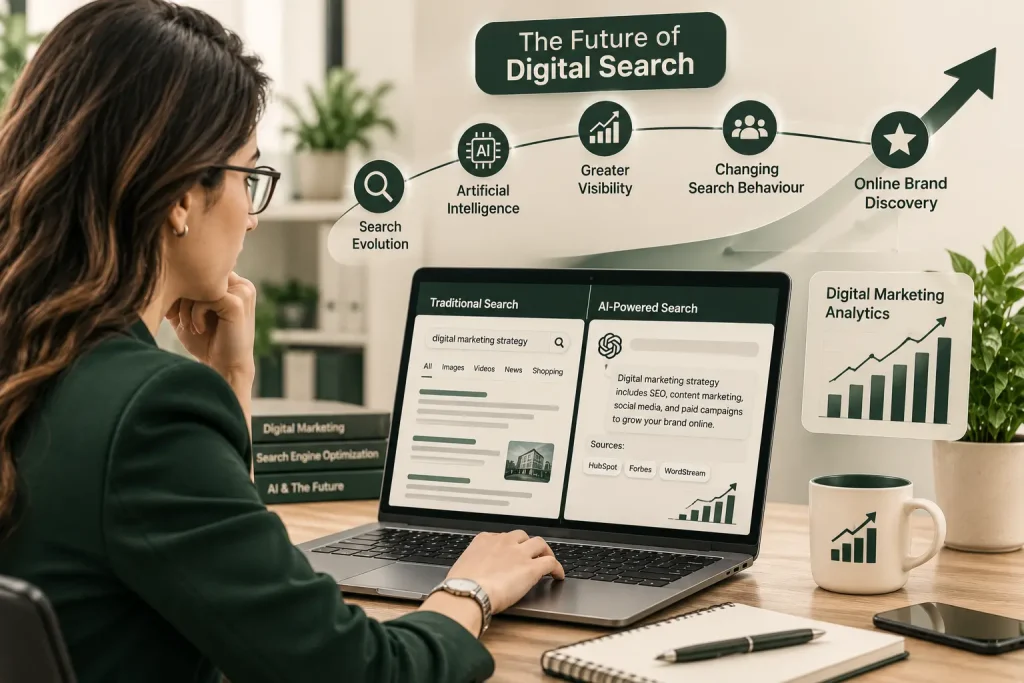
Understanding the difference between SEO and GEO
With the rise of AI technology, people are beginning to search for information in different ways. Traditionally people would search information using search engines such as Google and Bing. However, with the rise of AI people are beginning to search for information in AI powered searches.
Currently, users can now search for information using technologies such as ChatGPT Search, Google AI Overviews, Google AI Mode and Microsoft Copilot.
As a result, Generative Engine Optimisation (GEO) has become a key consideration within digital marketing.
Where SEO looks to improve the visibility of your website in search results, GEO aims to improve the visibility and referencing of content within AI results.
However, it’s important to know whether GEO is replacing SEO, what the difference between these strategies are and what businesses should prioritise in 2026.
In this article we will identify the differences between SEO and GEO, understand how they can work, examine the benefits and understand how businesses can benefit from using both strategies to improve their online visibility.
What Is SEO (Search Engine Optimization)?

Search Engine Optimisation (SEO) allows companies to appear in search results in an organic way so that relevant traffic is directed to your website.
As part of this, search engines will be able to understand the content of your website, determine how relevant it is for searches and display pages containing relevant information to users.
Therefore if someone searches ‘Best Digital Marketing Agency for small businesses’, the search engine (Google) will display websites relevant to the search.
Businesses will apply SEO tactics in order to increase their likelihood to be displayed in organic search results.
Key Elements of SEO
SEO involves several important activities that work together to improve website performance.
1. Keyword Research: Identifying relevant search terms and phrases that potential customers use to find information, products or services.
2. On-Page SEO: Optimizing page titles, meta descriptions, headings, URLs, content and internal links to improve relevance and usability.
3. Off-Page SEO: Building website credibility through relevant backlinks, brand mentions and other external signals.
4. Technical SEO: Improving website crawling, indexing, site structure, mobile usability and technical performance.
5. Content Optimization: Creating helpful, relevant and informative content that satisfies user search intent.
The main objective of SEO is to improve organic search visibility and connect businesses with people looking for relevant information.
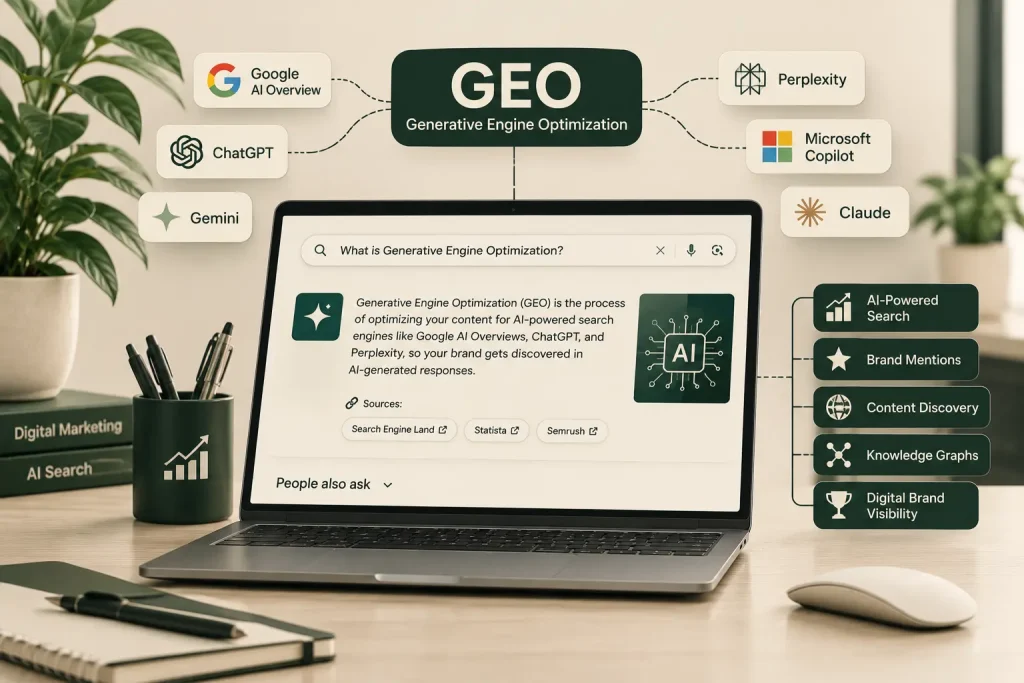
What Is GEO (Generative Engine Optimization)?
Generative engine optimisation (or GEO) is optimising content on websites so that Generative AI search results can pick up, understand and include content from a site in order to answer search queries.
Where traditional search results deliver a list of links to websites, AI powered search results are able to give natural language answers by pulling together information from various sources.
For example if a user asks:
“Which digital marketing agency provides SEO, Google Ads and social media marketing services?”
AI may pull together information from several sites and give the user a natural language answer. In addition to this, the AI may include references to the sources it used.
GEO aims to make information from a brand useful, easy to access, relevant and easy to understand in AI discovery results.
However, it is not guaranteed that a website will be referenced in AI results.
Key Elements of GEO
Key aspects to include within GEO
1. Informative
Content should be informative in order to be of value to users.
2. Clear
Use clear section headers, concise paragraphs, definitions, bullet lists and relevant examples.
3. Authoritative
Ensure you have an authoritative brand by including accurate business information, authentic reviews, original research and relevant mentions within your content.
4. Relevant
Ensure that content can clearly explain topics and relate relevant services, concepts and requirements to customers.
5. Searchable
Ensure key content on the site is easily found by relevant search engines. Also ensure that technical SEO has been well implemented.
Overall, GEO aims to make valuable information on a site easier to find within AI searches, improving it’s chance for being referenced.
SEO vs GEO: What Is the Difference?

SEO and GEO both aim to improve online visibility, but they focus on different search experiences.
SEO primarily focuses on organic search engine results, whereas GEO considers how information can be discovered and referenced in AI-generated responses.
Here is a detailed comparison:
| Comparison factor | SEO | GEO |
|---|---|---|
| Full form | Search Engine Optimization | Generative Engine Optimization |
| Main focus | Organic search visibility | AI-generated answer visibility |
| Primary environment | Traditional search engines | Generative AI search experiences |
| Content strategy | Relevant and optimized website content | Helpful, contextual and trustworthy information |
| User experience | Search results and website links | Conversational answers and supporting sources |
| Optimization | Keywords, technical SEO, content and links | Content quality, context, credibility and accessibility |
| Performance measurement | Rankings, impressions, clicks and organic traffic | AI mentions, citations, referral traffic and conversions |
| Main objective | Attract relevant organic visitors | Improve opportunities for discovery in AI responses |
Example: SEO vs GEO in Real Life
Say you are a Digital Marketing company and would like more people to find out about your SEO services.

– Traditional SEO
Create content on your service with keywords in the title, headings, body, fast load speeds and internal linking. This will aid SEO visibility in search engines.
– GEO
Create high quality information for people to understand about SEO, including benefits, cost considerations, frequently asked questions and examples. Ensure you have correct business information. Build authority using relevant content on the web.
Make sure information is of good quality to help people find it in different ways (including AI search).
Either way, you can increase visibility and customers to your business.
How Does SEO Work?
SEO helps search engines to:
Find pages on websites
1. Crawl pages
2. Index pages
3. Rank pages according to relevance
1. Crawling
The search engine finds web pages by following links.
2. Indexing
Search engines will process and store suitable information from web pages in order to be able to provide relevant results.
3. Ranking
When performing a search, a search engine will rank pages based on several factors to give users the most relevant and useful results.
4. Organic Search Results
As a result of ranking, users may be directed to relevant web pages and be able to view the information available within these pages.
If a client searches “social media marketing services,” then a well optimised website from an agency may appear in organic search results.
How Does GEO Work?

What is GEO?
GEO improves the visibility and usefulness of information within AI search tools.
Different AI tools will have different methods of searching, sorting and providing answers.
In summary, the steps involved could be:
1. Finding information
Searches for relevant information from within available resources on the web, indexes and other sources.
2. Retrieving information
Retrieves information which may be useful to answer the question.
3. Understanding information
Analyzes information to understand it and how it relates to other information.
4. Providing an answer
Uses the relevant information to provide a conversational answer to the question.
5. Citing sources
Within certain AI tools, sources may be listed, cited or linked within the answer.
An example could be if someone asked what the benefits of SEO are for small businesses. Within AI search results, information would be gathered from multiple marketing websites. From this information, a concise answer may be given.
Therefore, accurate, relevant and well structured content on websites is valuable.
Why Is GEO Becoming Important Alongside SEO?
Why is GEO important?
With people now being able to search for information and compare services in new ways with AI, businesses need to be aware of how this may affect their visibility within searches.
5 Reasons Why GEO Matters-
1. Improved Search Queries
As queries are becoming more conversational, people will be asking more specific questions.
Instead of ‘SEO services,’, people may search:
“How can a small business improve its Google rankings without spending too much money?”
Businesses can create content to answer these specific questions to help provide value to the customer.
2. Increased Visibility For Brands
As people search in new ways using AI, they may come across new websites and businesses based on the AI-generated responses and references.
This means there are more opportunities for your brands to be found by customers.
3. Improves Brand Trust
GEO means that businesses must ensure that they give accurate information, unique insight and consistent brand information.
This can help to improve high-quality content and trustworthy brands.
4. Reach Customers On Different Search Platforms
Customers may interact with Google Search, AI-Search tools and voice assistants at different points in the buyer journey.
If businesses have useful and easily accessible information on their website, they can effectively reach these customers depending on what search method they are using.
5. Adapting To Future Digital Marketing
As search methods evolve AI discovery is becoming an increasingly significant aspect of digital marketing.
Businesses who have good SEO, useful content and trustworthy brand information will adapt better to changing search methods.
Top 7 SEO Strategies for Better Organic Search Visibility
Top 7 SEO Strategies for Better Organic Search Visibility-
Ensure that you optimise your site with SEO.
Tactics to consider
1. Use keywords
Research what words or phrases your ideal audience would be using to search for your product/service.
Include appropriate keywords in the title, heading, URL and content.
2. On-page optimisation
Optimise title, meta description, headings, alternative text and internal links.
Ensure that each page is focused on one topic, and relevant.
3. Quality content
Ensure that your content is original, valuable and meets the searchers’ intent.
Avoid producing pages just for keyword stuffing and avoid targeting several similar keywords without providing any real value.
4. Technical Optimisation
Ensure that the website is crawlable by search engines, mobile friendly, secure and provides an easy to use experience.
Ensure that there are no broken links, and issues with indexing, duplicate content or unnecessary redirects.
5. Inbound Links
Create inbound links from reliable websites. Ensure that this is done by creating original research, valuable resources, contributing to the industry and building genuine relationships.
6. Optimise performance
Ensure that the website loads quickly, images aren’t too large, mobile friendly and provides a good experience on the page.
7. Measure SEO
Using Google Search Console and analysis tools ensure that we can measure impressions, clicks, traffic, what people have searched for and conversions.
Top 7 GEO Strategies for Better AI Search Visibility
Here are 7 best practices for optimal visibility in AI search results.
1. Provide Useful Information
Provide useful information.
Include practical examples, observations within the industry, original research and clear explanations.
2. Answer Questions
Include titles based on common questions. Include short answers in the following paragraph(s).
For example:
What is the difference between SEO and GEO?
Whilst SEO improves visibility in natural search results, GEO improves visibility, and possible citation, in AI generated results.
3. Structure the Information
Make use of descriptive sub-headers (H2, H3), bullet points, comparison tables and short paragraphs.
Well structured content makes it easier for both people and search engines to understand.
4. Provide Accurate Business Information
Ensure that key business information such as name, services provided, contact details and other relevant details are consistent across your website and credible business listings.
5. Reference Reliable Information
Include references to official documentation, reliable research within the industry, or external sources to support key statements.
Avoid using statistics or statements without supporting evidence.
6. Ensure Technically Accessible
Ensure that key content on your website is accessible to relevant search engines.
Have a clear structure on your website. Provide useful internal links. Have up-to-date site maps.
7. Monitor AI Visibility
Monitor performance in AI search results. Record referral traffic, mentions of brand, citations and business inquiries.
As AI search results may differ between searches, do not consider individual searches as a true representation of how well you are ranked.
Can SEO and GEO Work Together?
Yes.
Traditional SEO benefits websites by improving discoverability, content indexing, relevance and performance in natural search.
GEO works well in addition to traditional SEO to improve discoverability and referencing of useful content within generative AI.
Within an educational piece about digital marketing, businesses can perform the following:
– Keyword research to find relevant search queries.
– Optimise content for natural search.
– Structure content with clear subheadings.
– Direct answers to common questions.
– Credible references and unique insight.
– Ensure content is easy to understand.
– Monitor natural and AI traffic.
By doing this, businesses are creating useful content so users can benefit regardless of the type of search they undertake.
Best Tools for SEO and GEO Optimization
Tools
1. Google Search Console
Monitor your site’s performance in organic search, identify any issues with indexing, see what search terms you are being found by and how visible your website is.
2. Google Analytics 4
See what traffic your website is getting, what users are doing on it, where they came from and conversion rates.
3. Semrush
Perform keyword research, competitor analysis, backlink analysis, and audit your website.
4. Ahrefs
Analyse backlinks, perform keyword research, competitor research and find content opportunities.
5. Screaming Frog SEO Spider
Identify technical issues with your site, broken links, duplicated meta tags and crawl issues.
6. ChatGPT
Get ideas on content, outline content and research questions that customers may have. Improve clarity of content.
7. Google Gemini
Research information, create content, get ideas and plan marketing.
8. Bing Webmaster Tools
See how your site is performing in crawling, indexing and Bing and other AI powered searches.
While none of these tools guarantee rankings in SEO or citations in GEO, they are useful tools in researching, implementing and measuring.
Common SEO and GEO Mistakes Businesses Should Avoid
Avoid these mistakes within your SEO/GEO strategies.
1. Duplicate Keywords
Creating content with many repeated keywords will be confusing for readers.
2. Generic Content
If you simply copy and paste information from elsewhere without providing any useful new insights, you won’t be creating any real value.
3. Ignoring Technical SEO
Important content should be easy to find by the search engines.
4. Creating Fake Links and Mentions
Creating fake links and misleading reviews won’t help to create trustworthy content.
5. Not Considering Intention
Content should address the problems/ questions of your target customers.
6. Guaranteed Results
With SEO and GEO there cannot be guaranteed results. So it is impossible to guarantee higher search engine rankings, more traffic, AI citations or mentions.
7. Not Refreshing Content
Ensure that previous content is reviewed frequently to ensure that it is not out-of-date. This will also mean that the content is more valuable.
SEO vs GEO: Which Strategy Should Businesses Choose?
Best approach:
Both approaches should be used in combination.
If you want to improve your visibility within Google searches, consider:
– Keyword optimisation
– On-page SEO
– Informative content
– Backlinks
If you want to improve your visibility within AI searches, consider:
– Unique information
– Easy-to-understand information
– Established credibility
– Technical accessibility
In order to create an effective digital marketing strategy, aim to:
– Have good SEO
– Provide useful and unique content
– Provide clear answers to customer queries
– Ensure consistent brand information
– Ensure technical accessibility
– Include relevant internal and external links
– And regularly monitor results.
– Best strategy
Ensure that people can easily find reliable information, and that they can find you easily.
How DigitKraft Helps Businesses Improve Their Online Visibility
SERVICESWe bring creative, strategic and technical solutions to digital marketing.
With the changes taking place within digital search, it is important that we apply digital marketing strategies that will help your brand and audience, and improve growth.
We can help improve your online presence so that you can effectively engage with your target audience.
Digital Marketing-
1. SEO
We optimise websites, identify appropriate keywords, make content improvements and apply technical SEO to improve organic visibility.
2. Content Marketing
We deliver engaging and informative content to communicate knowledge and help your desired audience.
3. Social Media Marketing
We produce social media strategies to increase brand recognition, effectively engage audiences and communicate with businesses.
4. Google Ads
We create targeted campaigns to allow you to effectively reach the right audience.
5. Email Marketing
With strategic email marketing, we can engage customers.
6. CMS Development
We can develop and manage websites to allow you to meet your digital marketing goals.
What we offer
We create valuable digital experiences for businesses to adapt to changes in digital discoverability.
Improve your online presence
Get in touch with us to find digital marketing solutions to help achieve your business goals.
Conclusion
SEO and GEO are both very valuable concepts within digital marketing.
Where SEO aims to increase the visibility of web content within organic search results, GEO aims to make web content more discoverable and referenceable within AI search results.
Both SEO and GEO have many similarities, including high quality, clear information, technical accessibility and user centricity.
Although they are different techniques, businesses should consider implementing both SEO and GEO to provide better adaptability to changes in search.
When AI powered search evolves, businesses which provide high quality, trustworthy information with added value to customers will be best placed to adapt.
Create an intelligent digital presence with DigitKraft.
Frequently Asked Questions
No. GEO is not replacing SEO. Traditional SEO remains an important foundation for website crawling, indexing, content quality and search visibility across many AI-powered search experiences.
Neither is universally better. SEO is important for traditional organic search visibility, while GEO addresses discoverability in generative AI search experiences. Businesses can benefit from combining both approaches.
Create original content, conduct keyword research, answer customer questions, improve technical SEO, organize information clearly and maintain consistent brand details across credible online sources.
Yes. Small businesses can use GEO-related content practices to improve the quality and discoverability of their online information while continuing to invest in traditional SEO.
There is no fixed timeline. SEO performance depends on factors such as competition, website quality, content and technical health. AI search visibility is also variable and does not follow a guaranteed timeline.
