
Uncategorized
Uncategorized
What Is SEO and How Does It Help Your Business Grow?
In today’s digital world, having a website is not enough to make your business successful. With millions of websites competing for attention, businesses need effective strategies to help potential customers discover their products and services online. What is SEO? Whether you own a small business, a start up, online store or digital marketing company, using SEO can help your business gain more exposure and reach relevant audiences. From here, you can begin to grow your business. When people search for products/services on google, they will typically look at the most relevant results. If your website is SEO optimised, you have a greater chance of appearing here and reaching potential customers. So what is SEO? How does it work? And how can it help you grow your business? Here we will explain what SEO is, different types of SEO, how search engines work, the benefits of SEO and some actionable strategies to improve your online presence. What Is SEO (Search Engine Optimization)? SEO (Search Engine Optimisation) aims to increase organic traffic to a website. SEO is achieved by optimising content, structure, performance and other relevant aspects of a website to allow search engines to better understand what a page contains, and match search terms to the correct web pages. Example If a user types “best digital marketing agency for small businesses,” into Google search engine, they will be shown a list of relevant webpages which could provide them with the service or information they are looking for. If your agency’s website is well optimised and is relevant to the search term, there is an opportunity that your website may show up in the organic search results. The key aim of search engine optimisation is to improve the ease at which users can find, understand and get value from your website. Furthermore, attracting people who truly have interest in your business. How Do Search Engines Work? Search engines such as Google will crawl, interpret, and structure content across the web. Process- 1. Crawl The search engines (Bots) will crawl pages and view public content across websites. When an article is posted on a website and linked to in another place of the site, Google may identify the new URL. 2. Index Once a page has been crawled, search engines will interrogate the content (words, images, headings, etc.) and determine what they are. If appropriate, information from the page may be added to the search engines index. As a result, relevant information can be found when a person makes a search. 3. Rank & Return Results When someone makes a search, the search engine will search for relevant and useful information. Relevant results will then be returned to the user. For example, if a person typed in ‘SEO Services for small businesses’ into Google, pages offering SEO services, articles, local service providers and other search features may be returned. By optimising their content using SEO, businesses can increase the likelihood of showing in a relevant organic search position. How Does SEO Help Your Business Grow? As well as increasing search engine results page (SERP) ranking, SEO can assist companies with various aims such as; brand recognition, web traffic, lead and customer generation and future business development. Below are 8 areas in which SEO can positively affect a company. 1. Increased Website Visibility Customers will often use the internet to search for particular goods and/or services. Being shown on SERPs relating to these searches can therefore allow customers to locate a company’s website. SEO is used to optimise a company’s content, alongside how websites are organised and function so that it can be shown for pertinent searches. For instance, local bakeries can develop optimised webpages for their goods and services to boost the likelihood that their site is shown to local customers, for relevant searches. 2. Targeted Organic Web Traffic Whilst not all individuals that visit a web page will be interested in a company, it is vital that those that do visit are interested in the firm’s goods and/or services. Companies can utilise SEO to show their website for pertinent searches and so direct suitable people to it. For example, a person is more likely to be keen to engage a website designer if they search for ‘cheap website designers’ rather than seeking a definition of what website design is. Companies can analyse search intent and then develop content that appeals to their target market. 3. Brand Recognition and Trust Many people learn about brands as they seek answers to issues that they face. Continuously showing good quality information for pertinent searches can further a company’s brand recognition. Alongside this, beneficial blog posts, detailed service information, customer feedback and factual company data can all enhance a company’s perceived level of trustworthiness. Although SEO does not automatically imply trust, good user experience can assist in generating customer confidence. 4. Lead and Customer Generation Companies can use SEO to link with people that are looking to engage the company’s services. If an individual searches for a ‘social media marketing agency near me’, it is likely that they are already contemplating employing a marketing agency. Providing good, relevant information regarding a company’s services together with an easy method of contacting the business can transform this person into a lead. To further boost a company’s lead generation, it can provide: – Information outlining its services. – An online contact form. – A button for customers to message the company via WhatsApp. – Customer feedback. – Good quality calls-to-action. – Appropriate case studies and portfolio material. 5. Ongoing Marketing Benefit Although paid for web traffic can be generated during active marketing campaigns, organic web traffic can continue to be attracted to a company’s site even after content has been published. Nevertheless, SEO is not static. As time passes, search engine rivalry, content, a website and search engines themselves can all alter. Frequently refreshing content, alongside conducting technical and performance related website upkeep, allows companies to sustain and further enhance their organic web traffic. Enabling Small Companies […]

SEO vs GEO: What’s the Difference?
Understanding the difference between SEO and GEO With the rise of AI technology, people are beginning to search for information in different ways. Traditionally people would search information using search engines such as Google and Bing. However, with the rise of AI people are beginning to search for information in AI powered searches. Currently, users can now search for information using technologies such as ChatGPT Search, Google AI Overviews, Google AI Mode and Microsoft Copilot. As a result, Generative Engine Optimisation (GEO) has become a key consideration within digital marketing. Where SEO looks to improve the visibility of your website in search results, GEO aims to improve the visibility and referencing of content within AI results. However, it’s important to know whether GEO is replacing SEO, what the difference between these strategies are and what businesses should prioritise in 2026. In this article we will identify the differences between SEO and GEO, understand how they can work, examine the benefits and understand how businesses can benefit from using both strategies to improve their online visibility. What Is SEO (Search Engine Optimization)? Search Engine Optimisation (SEO) allows companies to appear in search results in an organic way so that relevant traffic is directed to your website. As part of this, search engines will be able to understand the content of your website, determine how relevant it is for searches and display pages containing relevant information to users. Therefore if someone searches ‘Best Digital Marketing Agency for small businesses’, the search engine (Google) will display websites relevant to the search. Businesses will apply SEO tactics in order to increase their likelihood to be displayed in organic search results. Key Elements of SEO SEO involves several important activities that work together to improve website performance. 1. Keyword Research: Identifying relevant search terms and phrases that potential customers use to find information, products or services. 2. On-Page SEO: Optimizing page titles, meta descriptions, headings, URLs, content and internal links to improve relevance and usability. 3. Off-Page SEO: Building website credibility through relevant backlinks, brand mentions and other external signals. 4. Technical SEO: Improving website crawling, indexing, site structure, mobile usability and technical performance. 5. Content Optimization: Creating helpful, relevant and informative content that satisfies user search intent. The main objective of SEO is to improve organic search visibility and connect businesses with people looking for relevant information. What Is GEO (Generative Engine Optimization)? Generative engine optimisation (or GEO) is optimising content on websites so that Generative AI search results can pick up, understand and include content from a site in order to answer search queries. Where traditional search results deliver a list of links to websites, AI powered search results are able to give natural language answers by pulling together information from various sources. For example if a user asks: “Which digital marketing agency provides SEO, Google Ads and social media marketing services?” AI may pull together information from several sites and give the user a natural language answer. In addition to this, the AI may include references to the sources it used. GEO aims to make information from a brand useful, easy to access, relevant and easy to understand in AI discovery results. However, it is not guaranteed that a website will be referenced in AI results. Key Elements of GEO Key aspects to include within GEO 1. Informative Content should be informative in order to be of value to users. 2. Clear Use clear section headers, concise paragraphs, definitions, bullet lists and relevant examples. 3. Authoritative Ensure you have an authoritative brand by including accurate business information, authentic reviews, original research and relevant mentions within your content. 4. Relevant Ensure that content can clearly explain topics and relate relevant services, concepts and requirements to customers. 5. Searchable Ensure key content on the site is easily found by relevant search engines. Also ensure that technical SEO has been well implemented. Overall, GEO aims to make valuable information on a site easier to find within AI searches, improving it’s chance for being referenced. SEO vs GEO: What Is the Difference? SEO and GEO both aim to improve online visibility, but they focus on different search experiences. SEO primarily focuses on organic search engine results, whereas GEO considers how information can be discovered and referenced in AI-generated responses. Here is a detailed comparison: Comparison factor SEO GEO Full form Search Engine Optimization Generative Engine Optimization Main focus Organic search visibility AI-generated answer visibility Primary environment Traditional search engines Generative AI search experiences Content strategy Relevant and optimized website content Helpful, contextual and trustworthy information User experience Search results and website links Conversational answers and supporting sources Optimization Keywords, technical SEO, content and links Content quality, context, credibility and accessibility Performance measurement Rankings, impressions, clicks and organic traffic AI mentions, citations, referral traffic and conversions Main objective Attract relevant organic visitors Improve opportunities for discovery in AI responses Example: SEO vs GEO in Real Life Say you are a Digital Marketing company and would like more people to find out about your SEO services. – Traditional SEO Create content on your service with keywords in the title, headings, body, fast load speeds and internal linking. This will aid SEO visibility in search engines. – GEO Create high quality information for people to understand about SEO, including benefits, cost considerations, frequently asked questions and examples. Ensure you have correct business information. Build authority using relevant content on the web. Make sure information is of good quality to help people find it in different ways (including AI search). Either way, you can increase visibility and customers to your business. How Does SEO Work? SEO helps search engines to: Find pages on websites 1. Crawl pages 2. Index pages 3. Rank pages according to relevance 1. Crawling The search engine finds web pages by following links. 2. Indexing Search engines will process and store suitable information from web pages in order to be able to provide […]
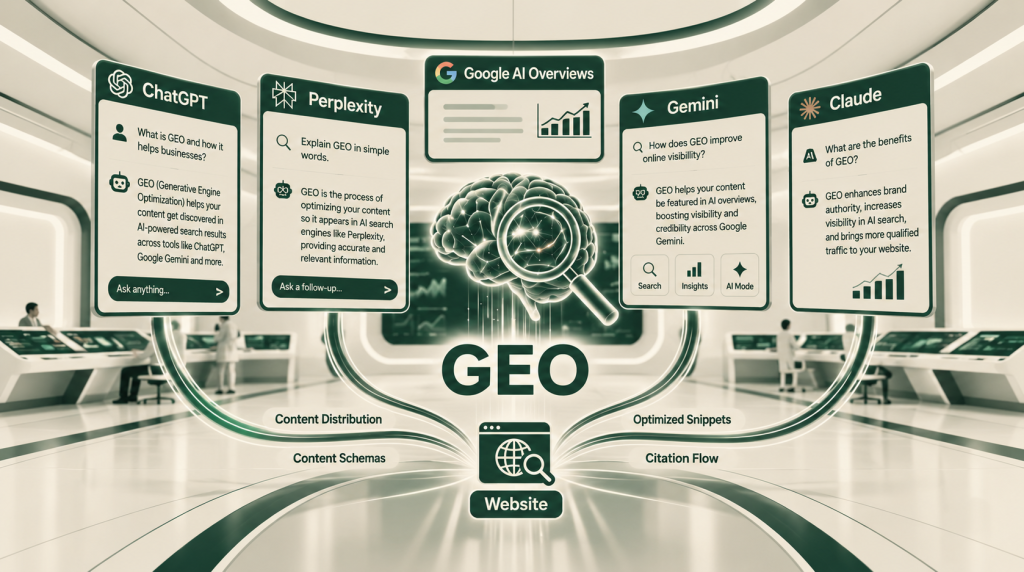
What Is Generative Engine Optimization (GEO) and Why Does It Matter?
With the rise of AI, users can now be given conversational answers to the questions they have based on various sources found online, changing the way people search for information online. Previously, users would search using search engines such as Google and Bing. However, with technologies such as ChatGPT, Google AI Overviews, Google AI Mode and Microsoft Copilot, users can now search in this new fashion.Opportunities and challenges arise for brands as a result of this. What is Generative Engine Optimisation? Generative Engine Optimisation (GEO) is a form of digital marketing that aims to improve the way your brand’s content can be searched, understood and (potentially) cited by AI search capabilities. Therefore, whilst traditional SEO remains important to have good visibility on your own website, producing useful, reliable and well-structured content in order to support AI searches is now becoming very valuable for businesses. Within this article, we will provide you with details about what Generative Engine Optimisation is, how it works, differences between it and traditional SEO and why it should be considered by businesses. What Is Generative Engine Optimization (GEO)? Generative SEO (GEO) refers to optimising content and brands on websites, to ensure that they will be found, interpreted and possibly referred to by generative AI systems. Differences from SEO Where traditional SEO aims to help increase the visibility of a website within search results, Generative SEO takes into consideration how the information within content from various sources will be found, interpreted and used by AI systems to create answers. Example- If a user asks an AI-powered search system: “Which digital marketing agency provides SEO and social media marketing services?” The AI powered search system will provide an answer based on multiple sources across the internet. A businesses information content which is relevant, accurate, easily accessible and trustworthy has a higher chance of being included or referred to within these answers. Although Generative SEO does not guarantee inclusion within AI answers, it helps improve the quality, ease of access and value of information on the web. How Does Generative Engine Optimization Work? Optimising content for generative AI systems Many AI search tools will use retrieval methods and retrieval augmented generation (RAG) to find relevant information. Within Generative Engine Optimisation, information can be found from available sources, and used to produce answers. Simplified steps for Generative Engine Optimisation- 1. Find content AI search tools search through search indexes, retrieval systems and other sources to find relevant information. 2. Find relevant information In response to queries from users, the system finds relevant information to answer them. 3. Understand information The system understands what information is relevant, and understands the context of this information. It also understands how different pieces of information relate. 4. Produce an answer Using the relevant information, the AI creates a natural language answer. 5. Link to sources Depending on the platform, the system may include links to the sources that were used. For example, if a user was asking about the benefits of SEO services, an AI powered platform may pull together information from multiple marketing sites and provide a concise answer. Links to the relevant sources may also be included. As a result, it is important for businesses to produce useful, accurate and well organised content, as opposed to just placing certain keywords. What Is the Difference Between SEO, AEO and GEO? SEO, AEO and GEO are related digital marketing concepts, but they have different areas of focus. Understanding their differences can help businesses develop a more complete search visibility strategy. Factor SEO AEO GEO Full form Search Engine Optimization Answer Engine Optimization Generative Engine Optimization Main focus Search engine visibility Direct answers to user questions Visibility in generative AI responses Content approach Relevant, optimized website content Clear, question-based answers Helpful, contextual and trustworthy content Main objective Improve organic search visibility Make information easy to use as an answer Improve opportunities for AI discovery and referencing Examples Google Search, Bing Featured snippets and answer-focused search experiences ChatGPT Search, AI Overviews and Copilot SEO Improving search rankings in standard search engines. Includes keyword research, on-site optimisation, technical SEO, content creation, internal links and acquiring relevant backlinks. AEO Improving the readability and usability of information to provide answers to targeted questions within search engines. Examples of this include clear definitions, heading titles with questions and short answers to common questions customers may have. GEO Making useful information on a website easy to find and understand by generative AI systems in order to produce conversational answers. Includes high quality content, contextual information, clear information, a credible brand, and technical accessibility. Note: Although SEO, AEO and GEO are different, they can be used in conjunction with each other to improve your brand’s visibility online. Why Does Generative Engine Optimization Matter for Businesses? Opportunities for brands to engage with audiences using conversational search have increased due to the development of AI based searches. GEO is useful for brands as it encourages creation of useful content. Key benefits of GEO for businesses include: 1. Adapting to changing search behaviour Customers are using conversational search terms in order to find information. Customers may search for complex questions, such as; “Which digital marketing strategy is best for a small business?” Therefore, businesses should create content answering these questions. 2. Greater brand visibility Using AI based search content can give businesses greater visibility to new audiences. Having relevant information on your website and in credible sources may increase your visibility in a variety of search formats. 3. Gain authority as a brand It is very important to gain trust as a brand online. By creating accurate content, providing knowledge within the industry, and explaining services, you can provide credibility. Having consistent branding information also increases credibility. Producing original research, expert knowledge, customer insight and valuable case studies will increase the value of content on your web pages. 4. Attracting potential customers at different points in their journey. Customers often perform research on […]
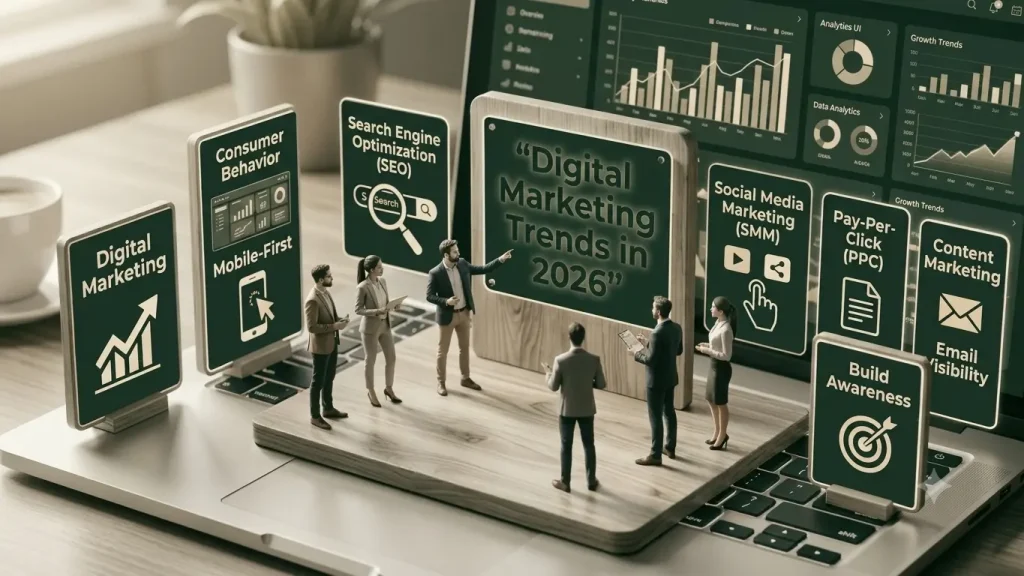
Top 10 Digital Marketing Trends to Watch in 2026
Trends in digital marketing are changing constantly. AI, customer changes in behavior and new technology all mean digital marketing strategies are changing. In 2026 digital marketing involves more than just social media content, advertising and increasing SEO. Businesses are beginning to use AI marketing, personalisation, AI search, short video content, social commerce and data driven marketing. Consumers are finding brands through a variety of digital methods such as search engines, social media, online groups and AI. As a result, businesses must adopt more clever digital marketing strategies. Understanding these current trends in digital marketing can really benefit your business, whether you run a start-up, SME or larger organisation. It can allow you to connect with new customers, increase brand awareness and create better relationships with customers. What are the main digital marketing trends businesses should be aware of in 2026, and how can they be used to grow your business? Here are 10 key digital marketing trends to be aware of. What Are Digital Marketing Trends? Digital marketing trends are new technologies, methods or behaviours within digital marketing. These trends allow businesses to better understand shifting customer expectations, so they can boost performance in marketing. Trends such as the use of AI, targeted advertising, influencer marketing, short videos, and AI powered search engines are increasing the way companies gain and engage customers. Understanding these trends means that businesses can adapt their marketing strategy in order to be more effective. Top 10 Digital Marketing Trends to Watch in 2026 1. Artificial Intelligence (AI) Is Transforming Digital Marketing AI is becoming a key tool in digital marketing. Companies are beginning to incorporate AI into their processes to increase efficiency, understand customers and personalise marketing. It improves efficiency in marketing and enables informed decisions. Key examples of the use of AI in marketing include: – Content creation. – Social media content scheduling. – Analysis of customerBehaviour. – Personalised product recommendations. – Chatbots. – Improving advertising campaigns. – Predictive analytics. AI can be applied in an online retail business to allow personalised product recommendations for customers, based on what they have previously bought/passed over on the site. Tools such as ChatGPT, Google Gemini, Canva AI and Adobe Firefly are increasing the efficiency of content generation in marketing, allowing ideas to be generated, research to be carried out and creative content to be created. How businesses can use this trend: Look for repetitive marketing tasks to improve with the help of AI. Pairing these new tools with creative and skilled human workers and appropriate quality control can increase efficiency and productivity in your marketing. 2. Generative SEO With more people using AI driven search tools to find information, consumers can now find products and solutions more easily. Generative SEO aims to help create useful, reliable content. This is so that content can be found, interpreted and potentially cited by generative AI search tools. As AI driven searches are on the rise, it is becoming increasingly important to provide clear, accurate and useful content. Key Generative SEO practices include: – Creating original, informative content. – Answering frequently asked customer questions. – Using clear subheadings. – Providing accurate relevant facts and reliable sources. – Increasing brand reliability and authority. – Ensure content is accurate and kept up to date. – Ensure important information is easily found by searchers. For example, if a digital marketing company has written a long blog post on their SEO services, within the blog they can define what SEO is, how it works, the benefits and common questions. This makes the content very useful for users and also easy to understand for search platforms. Business opportunities Create quality content which answers customers’ questions. Ensure you still follow basic SEO principles, but make sure content is informative, original and easy to follow. 3. Short Form Video Content Short form videos are becoming a popular way for businesses to market themselves. Platforms such as Instagram Reels, YouTube Shorts and other similar platforms can be used. These videos are generally preferred by customers as they are quick to watch and are able to give information, be entertaining or demonstrate products. Using short form video content allows companies to: – Show products and services. – Provide educational information. – Show how to use products. – Introduce brand and staff. – Share customer stories. – Promote offers. – Answer common questions. A digital marketing company may produce a 30 second video for Instagram Reels which tells businesses 3 common mistakes to avoid with SEO. Including short form video content in marketing can allow brands to showcase the value they provide, encouraging people to view their products/services. How to make the most out of this trend Produce valuable, engaging and genuine content. Although following trends can be useful, ensure that your content has a clear message, an engaging beginning and useful information. 4. Collaborating with Influencers Businesses can work with content creators to promote their products/services/brands to audiences. In 2026, Businesses are placing greater importance on building genuine relationships with creators, niche audiences and micro-influencers. Micro-influencers often have smaller audiences but can give businesses access to niche communities. Businesses can use Influencer Marketing for: – Branding – Demonstrating Products – Customer feedback – Promotion on social media – Launching new products – Engagement within communities A skincare brand could collaborate with a beauty creator, who regularly gives skincare advice and product experiences to an interested audience. This allows the brand to expose their products to the right audience. Practical Applications Focus on finding creators that match your audience needs, provide quality engagement, suit the style of content required and fit well with the brand, rather than just finding creators with a high following. Be transparent in any paid collaborations. 5. Social Commerce Social commerce refers to the ability to discover & purchase products on social media platforms. Discovering and purchasing products Social media platforms have become an effective way for users to discover and purchase products. Using social media platforms […]

How AI Is Transforming the Future of Digital Marketing in 2026
Artificial Intelligence (AI) has been used widely within digital marketing. Businesses can personalise and improve their marketing strategies using AI. AI has allowed companies to run targeted advert campaigns and make digital marketing overall more efficient. Businesses are no longer relying solely on manual research to understand their customers. Through AI technologies, marketers can understand consumer behavoiur, understand market trends, create engaging content, and improve marketing performance. With increased competition within the digital space, it is very important for businesses to begin incorporating AI into their digital marketing strategies. Whether you are a small business, start-up or well known business, there are many new opportunities that AI can bring to improve marketing and get the message to the correct people. How is AI impacting digital marketing? In this article we will look at the role of AI in modern marketing, how it can be used, the benefits it provides, issues faced and potential in the future. What Is AI in Digital Marketing? AI in digital marketing makes it possible to gain insights from data, better understand consumer behaviour, automate processes, and improve marketing strategies. AI enables brands to make smarter decisions in marketing. It can identify patterns, predict what consumers may be interested in, and personalise marketing to suit their needs. AI can be used by businesses to recommend products to consumers depending on their browsing habits, create social media content, analyse marketing performance and answer customer questions in chatbots. Using AI in marketing means that lengthy and time consuming processes in marketing can be completed much faster. A large amount of data can be processed quickly meaning brands can make better decisions in marketing. Overall, AI in digital marketing means that businesses can better understand their audience, provide relevant content, and increase marketing effectiveness by using intelligent technology. How Is AI Transforming the Future of Digital Marketing? Artificial intelligence is having a huge impact on digital marketing. Businesses can leverage AI to produce content, optimise sites, interact with customers and run marketing campaigns. Below are the key impacts AI is having on digital marketing. Key Impacts of AI in Digital Marketing- 1. AI-Powered Search Engine Optimization (SEO) AI is impacting SEO. By using AI within SEO, marketers can improve keyword research, understand search intent, identify content gaps, and improve performance of a website. Businesses can do the following by using AI: -Find new relevant keywords to target. -Analyse competitor content. -Find SEO improvements needed for your website. -Understand what search trends are and what search intent is. -Create new content ideas and outlines. -Track keyword performance and general performance of the site. Searches themselves are being impacted by AI. Users can now search using AI-powered searches (like AI Overviews on Google) and chatbots. As a result, businesses should create helpful, unique and structured content that directly answers questions customers may have. 2. Personalisation Customers are more engaged with marketing that is tailored to them. AI can allow businesses to personalise marketing to suit customer preferences by taking into account the users preferences, what they have browsed, what they bought, and how they interacted. An E-commerce website can suggest items to buy based on what a customer has previously purchased. Or an email marketing campaign can be tailored to send relevant offers to specific customer segments. Benefits of using AI in personalisation include: -Understanding customer preferences. -Relevant product suggestions. -Targeted email marketing. -Audience segmentation. -Increased customer engagement. -Improved customer relationships. Personalisation allows marketing to be more relevant and means that businesses can interact with customers at the right times. 3. Social Media Marketing Social media provides businesses with many opportunities to raise brand awareness, engage with customers and promote their services. AI can be used in social media marketing to make it more efficient. Marketers can understand what interests their audience, what type of content is popular and efficiently manage social media marketing. Marketers can use AI to: -Develop content ideas -Write descriptions/captions -Identify appropriate hashtags and popular topics -See how engaged audiences are -Plan content -Track brand mentions and customer feedback -Measure effectiveness of social media campaigns For example, a digital marketing agency could use AI to plan out a basic monthly content plan, get content caption ideas and to see which type of posts have higher engagement. However, to produce genuine content on social media, human creativity and understanding of branding is needed. 4. Content Creation AI tools can help you create content quicker and make your content creation process easier. With generative AI, you could create: -Blog outlines / posts -Website copy / product descriptions -Social media captions -Email content -Advertising headlines -Video scripts -Creative ideas and images For example, when a new product is launched, ideas can be generated via an AI tool to create effective marketing messages to put on your website, Instagram page and emails. However, content generated by AI should be checked before being published. Content should include original knowledge, correct information, realistic examples and maintain a consistent brand voice. The aim of using AI to create content should be to create higher quality content for the target audience. 5. Advertising Advertising can be made data driven using AI. It allows businesses to understand what customers are doing, understand how well ads are performing and optimise advertising. Many platforms such as Google Ads and Meta Ads include AI and Machine Learning tools to target, bid and optimise ad campaigns. Using AI in advertising can allow businesses to: -Find suitable audiences. -Understand the effectiveness of ads. -Try different versions of ads and messages. -Optimise bid strategies. -Find conversion opportunities. -Have more effective advertising. For example, a clothing company can use automated advertising features within their advertising to target people more likely to be interested in their product. Although AI can make managing advertising more efficient, marketers will still need to identify the objective of advertising, track how much money is being spent and analyse how effective it has […]